In today’s youth markets, what counts as valuable has changed. For Gen Z, value isn’t necessarily about utility, but about identity, symbolism, and participation. The rise of Labubu - Pop Mart’s breakout figurine - embodies this transformation. What looks like a mischievous, bug-eyed forest sprite is in fact a sophisticated vehicle for global brand expansion, powered by emotional branding, IP strategy, and the gamification of cultural capital.
From Blind Boxes to Brand Universes: Pop Mart’s IP Architecture
Labubu’s success is not accidental - it is engineered. At its core lies a meticulously designed IP model. Unlike traditional toys, which depend on character recognition or media tie-ins, Labubu thrives on controlled scarcity and symbolic value. Pop Mart’s blind box distribution system turns every purchase into a gamble: will the buyer receive a common edition - or a rare hidden figure? This simple mechanism generates not only repeat purchases but intense emotional engagement.
Behind the product is an entire IP universe: backstories, lore, themed events, social media campaigns, and region-specific collaborations. Pop Mart isn’t merely selling figurines - it’s selling entry into an aesthetic and emotional micro-world. This is what distinguishes character IP from ordinary merchandise: IP retains attention. It grows in meaning over time, offering new narratives, new attachments, and new ways for the consumer to participate.
This strategy is working. According to MoonFox Research Institute, Pop Mart’s revenue from Hong Kong, Macao, Taiwan, and overseas markets exploded from RMB 190 million in 2021 to RMB 5.07 billion in 2024.
See Figure 1: Pop Mart’s Overseas Revenue and Growth (2021–2024)
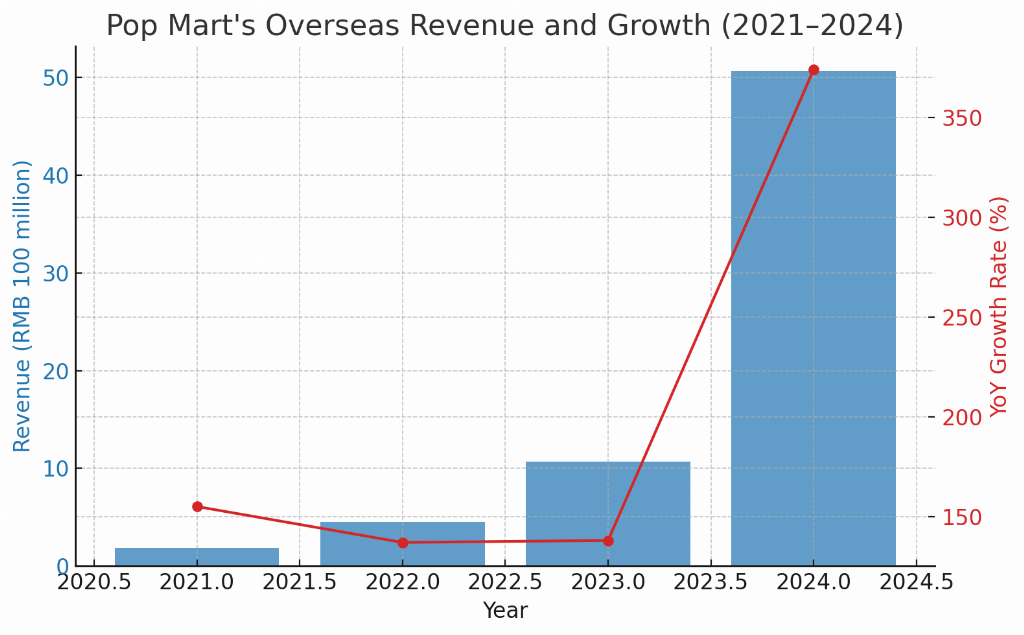
This growth is not just a function of market penetration—it is a result of scalable cultural storytelling that bridges geography, taste, and identity.
Cultural Capital as Strategy: What Gen Z Is Actually Buying
To understand why Labubu works, we must go beyond branding and consider cultural theory. French sociologist Pierre Bourdieu argued that individuals compete not only through economic capital, but through cultural capital - taste, knowledge, aesthetic literacy. In the case of Labubu, what Gen Z buys is not just plastic - it is symbolic fluency. It’s the ability to read and perform a shared language of irony, anti-mainstream cuteness, and emotional complexity.
Labubu’s design - intentionally asymmetrical, melancholic, even unsettling - mirrors the shift in Gen Z aesthetics away from perfection. These figures are not beautiful in a classical sense - they are emotionally legible, capturing moodiness, vulnerability, and humor. The figure becomes a kind of emotional avatar: weird, expressive, and, crucially, shareable.
Social media amplifies this effect. On platforms like TikTok, Shopee, and Xiaohongshu, users showcase rare pulls, arrange collection shots, and produce unboxing videos. In 2024, Pop Mart earned RMB 262 million via TikTok alone, a channel that not only sells but socially validates consumer behavior. This isn’t just marketing - it’s a self-reinforcing feedback loop where ownership becomes performance, and performance becomes value.
Labubu as Identity Infrastructure: Participation, Not Possession
Labubu’s cultural capital doesn’t just accrue through scarcity - it grows through participation. Every new collection drop, every theme café, every city-specific store expands the “Labubu universe,” giving fans opportunities to perform their membership. This matters because Gen Z does not view consumer identity passively. For them, consumption is a narrative tool - a way to write the self into cultural space.
Pop Mart has understood this, designing its overseas expansion not just as distribution, but as local cultural integration. Stores are not standardized. In Seoul, Labubu is sold in K-Pop-themed pop-ups; in Paris, in Louvre-style boutiques. Each spatial encounter allows users to re-encounter the product in culture, reinforcing the sense that owning Labubu is a kind of cultural literacy.
At a time when Gen Z faces instability - economic precarity, identity fluidity, digital overload - Labubu offers a small but meaningful sense of anchoring. It is playful but emotionally articulate; commercial yet personal. And in its weirdness, it allows users to feel both seen and unique.
The IP-Driven Future of Branding
Labubu exemplifies a powerful shift in branding: from product to platform. The character is not defined by a single storyline, film, or game. Instead, it is open-ended - pliable to social trends, adaptable to platform-specific formats, and responsive to fan reinterpretation. This is what makes it ideal for Gen Z markets: it invites co-authorship.
By building IPs that serve as emotional canvases, brands like Pop Mart move from transactional models to relational ecosystems. Every new drop is not just a sale, but a signal. Every variant tells a story. And every collector, through display, resale, or remix, becomes part of the narrative.
This approach unlocks a long-tail model of value creation. The consumer journey is no longer linear (awareness → interest → purchase) but circular: participation → expression → amplification → deeper attachment.
Conclusion: Labubu and the Meaning Economy
Labubu may be small, but it represents something profound: a model for how cultural meaning becomes economic value. Pop Mart’s success lies not just in creative design or market timing, but in understanding that Gen Z buys with emotion, collects for identity, and consumes to connect.
In this new landscape, the most successful brands won’t be those that speak the loudest - but those that can offer the richest, most resonant spaces for users to speak through. Labubu is no longer just a product. It is a platform for feeling, a symbol of aesthetic belonging, and a template for the future of consumption.
June 25, 2025
By Yi Li
